
Bike or car in a chase: which one actually wins?
Bikes are faster and fit anywhere, but one touch puts you on the tarmac. The right answer depends on your role and who's opposite — here's which, when.
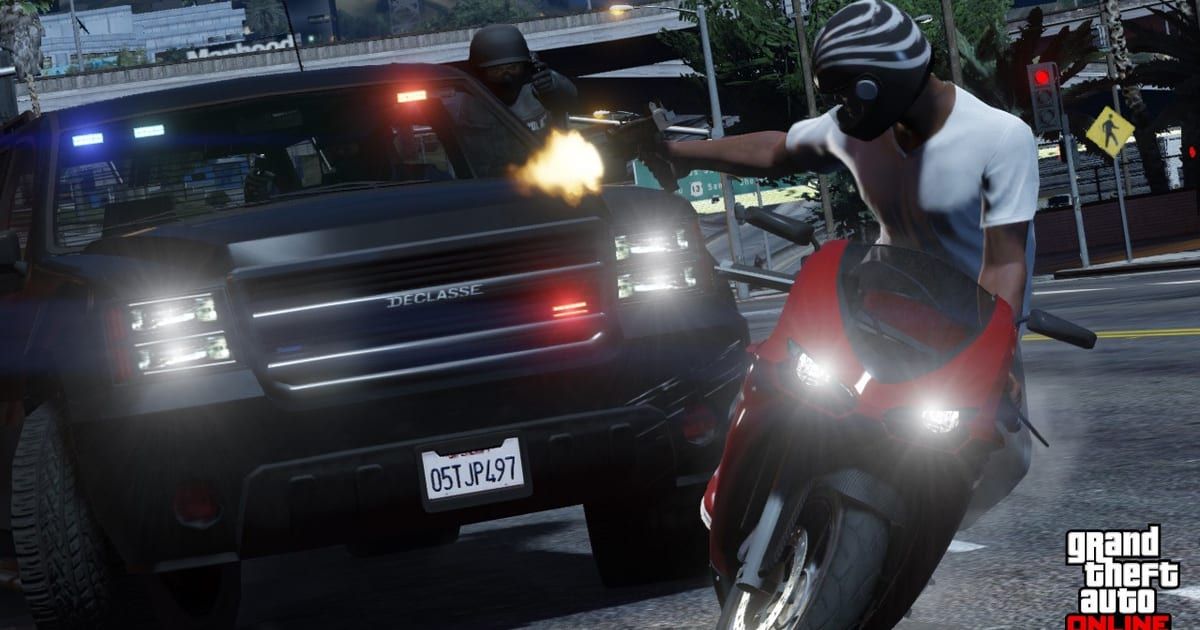
This is one of the rare GTA debates where both camps are right — and where almost nobody specifies in what context. Bikes are faster, sharper, and go where nothing else goes. Cars absorb punishment, protect you, and let you attack. Saying “bikes are better” or “cars are better” without naming the role and the opponent is answering a different question.
Here’s the honest comparison, then the verdict in three cases.
What the bike does better
Acceleration and speed. On open sections the best bikes in the game match just about anything. A bike pulling away from a junction opens a gap a car simply won’t close in a straight line.
Agility and footprint. This is the decisive advantage, more than speed. A bike goes between two cars in stopped traffic, up a kerb, down a staircase, through a pedestrian alley, through a half-open gate. Everything that’s a wall to a car is a door to a bike. In dense city driving that’s worth more than any stat line.
Off-road. A decent dirt bike — the Sanchez is still the benchmark — takes you off the road network in an instant. Mount Chiliad trails, the Vinewood hills, banks, medians: the bike goes, the car dies. It’s the most reliable escape technique against AI police, covered in how to lose the cops.
Multiplying your options. A bike gives you more choices at every intersection. A pursuer in a car can’t cover all of them, so they have to guess. Every guess they’re forced into is time you gain.
What the car does better
Taking a hit. This is the structural difference, and in some contexts it flattens everything else. A car takes contact, bounces, corrects, carries on. A bike takes contact and puts you on the ground. Not “slows you down” — it puts you on foot, at a standstill, needing time to get up and remount, assuming the bike hasn’t ended up in a wall much further down the road.
Attacking. A car gives you offensive contact. Squeezing, pushing, closing a line, landing a PIT — none of those tools exist on a bike. A bike rider can only run; they have no way to cost you time.
Forgiving mistakes. An error in a car costs a fraction of a second. The same error on a bike often costs the round. And a chase is one long series of imperfect situations: kerbs, accidental contact with traffic, late braking. A car absorbs all of it. A bike bills you at full price.
Protection. Against AI, bodywork shields you from gunfire. An armoured Kuruma outright solves the high-wanted-level problem; a bike leaves you fully exposed.
The comparison
| Criterion | Bike | Car |
|---|---|---|
| Acceleration, speed | Superior | Adequate |
| Agility, tight gaps | Excellent | Limited |
| Off-road | Excellent (dirt bike) | Model-dependent |
| Contact tolerance | Near zero | Good |
| Offensive contact | Impossible | Its main tool |
| Mistake tolerance | Low | Good |
| Protection from gunfire | None | Good |
| Vulnerability to traffic | Very high | Moderate |
Traffic vulnerability: the underrated factor
This is what decides most bike-versus-car outcomes, and it’s the least discussed. On a bike, your ability to thread through traffic is exactly what makes you vulnerable: you pass very close, very fast, and any civilian car changing lane at the wrong moment is a crash.
Put another way, the bike’s greatest strength and its biggest risk are the same property. The more you exploit the agility, the more exposed you are. A cautious bike rider throws away the advantage; an aggressive one gambles the round at every traffic jam. That’s what makes bikes thrilling — and statistically unstable.
Case 1 — Running from AI: take the bike
Against AI police the bike is excellent, and probably the best pick in the game.
Why: the AI doesn’t hunt for precise contact, it follows you and shoots. And your best defence against that isn’t armour, it’s leaving the road network — which is exactly what a bike does better than anything. A dirt bike climbing into the Vinewood hills or dropping into the Los Santos River channel sheds patrols in seconds.
The one caveat is high wanted levels, where gunfire becomes the primary threat. There the logic flips toward survival, and an armoured car becomes the better tool — the full reasoning is in the best cars for police chases.
Case 2 — Running from a player: the bike is a death sentence
Here the answer inverts completely, with no nuance at all.
A human hunts for contact. It’s their most efficient way to cost you time, and against a bike it’s absurdly cheap: they don’t need to place a precise move, they just need to touch you once. No PIT, no angle, no speed window. One graze and you’re on the tarmac.
What that changes in practice: your speed advantage stops existing, because you can’t use it while they’re near. You spend the chase avoiding contact instead of driving, so you run well below your potential — and you usually get hit anyway, often by a civilian car.
The only context where a bike stays viable against a player is when you already have a large gap plus terrain that forbids contact: narrow alleys, trails, stairs. In other words, the bike is good when you’re already winning. That’s the definition of a bad pick.
Case 3 — Hunting: the car wins nearly every time
As the hunter, there’s barely a debate.
Your goal isn’t to be faster than them — it’s to cost them time. And your only real tool for that is contact: squeezing, closing a line, pushing them wide, spinning them. A bike has none of those. You can ride it fast, but you can’t do anything with it.
Worse, as the hunter you’re the one initiating contact, so you’re the one exposed. On a bike every approach is a potential crash — you’d be the only one of the two who can lose from a graze.
The one realistic exception is a fully off-road pursuit, where your target has fled into terrain no car will follow. There a dirt bike is sometimes the only way to stay in touch. But you’ll be following, not stopping them.
The verdict, one line per context
- Running from AI: bike, almost always — except at high wanted levels, where survival wins.
- Running from a player: car. The bike is a death sentence the moment they go for contact.
- Hunting, against anyone: car. Contact is your tool, and a bike doesn’t have it.
The underlying rule: the bike wins against an opponent who can’t touch you, the car wins against everything else.
Where the debate disappears
What makes this question interesting is that it’s about a choice — and therefore, partly, about imbalance. Two players on different vehicles aren’t really playing the same game, and you never find out who was the better driver.
That’s what we removed on Chased: in our 1v1 hunter-versus-hunted duels, the car is randomly drawn and identical for both players. Nobody picks, nobody buys, nobody has a hardware edge. All that’s left is your line, your map reading and your nerve. A style score rewards drifting and near-misses, a seasonal ELO ladder sorts the field, and the short format is built for competition and for clips.
Next: the 10 mistakes that cost you a 1v1 and the best places to lose a pursuer in Los Santos.